Orchestrions, Organ Clocks, and the Mechanical Music Tradition
In a previous post, I wrote about “Orchestrion Hall” and the extraordinary collection housed there. It occurred to me afterward that the word orchestrion may not be widely understood today — so here is a closer look, along with photographs and videos.
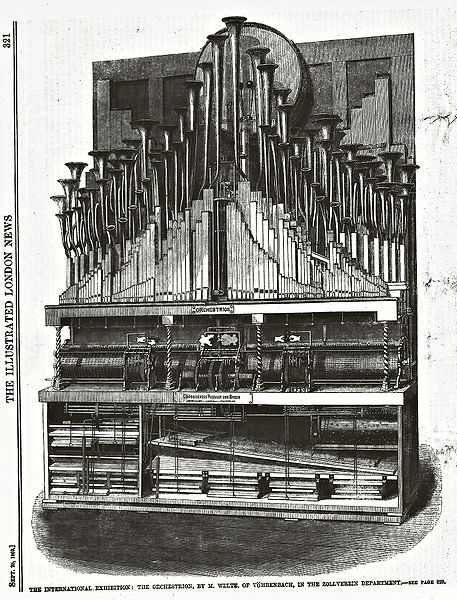
An orchestrion is a mechanical musical instrument built to imitate an entire orchestra. At its core is usually a large player pipe organ. Just as there have long been player pianos or pianolas that operate from punched rolls, orchestrions use punched paper rolls or cards to control air valves, bellows, and mechanical linkages. But an orchestrion goes far beyond a simple organ.
In addition to ranks of pipes, orchestrions often include drums, cymbals, piano mechanisms, castanets, triangles, bells, and sometimes even string instruments — all performing automatically from the same roll of music. The result is a self-contained mechanical orchestra, capable of filling a hall with remarkable sound.
Here you can see the internal mechanism of a Welte orchestrion. Notice the enormous bellows and air chest at the base — the lungs of the machine.
Below are several videos of notable orchestrions, including instruments from the magnificent collection at the Nethercutt Museum in Los Angeles. The first video was one I captured rather quietly when no one was looking.
The Mechanical Music Family
Followers of this blog know that we are fascinated by mechanical musical instruments of every variety: orchestrions, organ clocks, flute clocks, trumpeter clocks, cuckoo clocks, music boxes, and more. In many ways, the orchestrion stands as the grand patriarch of them all — the most ambitious expression of automated musical engineering.
Organ Clocks
An organ clock combines horology and music into a single unified instrument. Typically, the clock movement triggers a small pinned cylinder or interchangeable barrel that plays a tune on organ pipes at the hour (or at predetermined intervals). Some of the finest 18th and 19th century examples were built in England, Germany, and Austria, and were often housed in elegant cases resembling tall regulators or bracket clocks.
These instruments represent a fascinating marriage of disciplines: precision timekeeping paired with miniature organ building. The clock regulates time, while the organ celebrates it.
The Cuckoo Clock
Perhaps the most familiar musical clock is the Black Forest cuckoo clock. While mechanically simpler than an orchestrion, it operates on similar pneumatic principles. A small bellows system forces air through tuned wooden pipes to produce the iconic two-tone “cuckoo” call. Many examples also include music boxes that play melodies after the hour strike.
In essence, the cuckoo clock is a compact organ clock — distilled, whimsical, and domestic — whereas the orchestrion is its theatrical, grand-hall counterpart.
Below is another example demonstrating the scale and complexity of the orchestrion compared to its smaller cousins:
All of these instruments share a common spirit: the desire to automate music through ingenious mechanical means. They remind us that long before electronic amplification and digital playback, engineers and artisans were already building machines that could perform, accompany, and astonish.